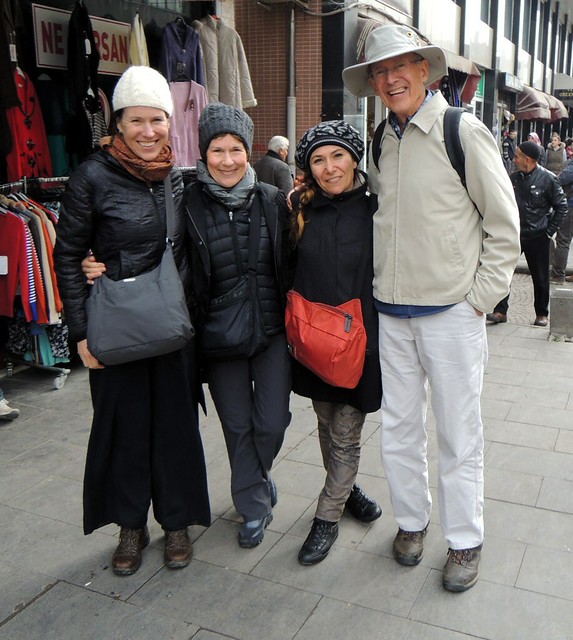
Continuing our auto tour of Upper Mesopotamia, the next stops were Midyat, Mardin, and Dara, all in the Turkish province of Mardin. I’d been wanting to visit the city of Mardin for years. It’s some travellers’ favourite place in Turkey. Dara’s an old Roman city with an extensive necropolis and incredible cisterns, but the real jewel of the area is Midyat.
Ferda, Megan, my parents, and I learned about the Syriac Orthodox Church, met Syriac villagers and visiting members of the diaspora, and learned about Syriac traditions as they’re still practised in Turkey. They’re still using the Syriac language, something similar to the more widely known Aramaic, the language of Palestine during Jesus’ time. Syriacs are teaching the language within the community, but it’s not taught at Turkish public schools. I heard the language spoken in at least one of the villages we visited (Altıntaş). We also saw the Syriac prayer book and bible which use the Syriac language and script. And of course we visited Syriac churches and monasteries that must be among the oldest Christian buildings in the world.
We drove into Midyat in late afternoon and happened upon this Syriac church while trying to find our hotel:

The priest there was quite talkative, gave Ferda a bible (in Turkish), and explained to her how Alevis aren’t really Muslims since they don’t follow Mohammed’s example literally (a very good thing in his opinion). We also learned that it was the Syriacs’ annual 50-day fasting time. They don’t eat any meat during that time, and they don’t eat at all after the evening meal until noon the following day.
Around the corner we found our hotel, everyone’s favourite of our week, complete with coffee, Syriac wine (of course), and a good breakfast.
Continue reading